NASA Targets to Get Mars in Just 45 Days

- ICON


VIVA – NASA's Innovative Advanced Concepts (NIAC) program will provide significant exploration funding for technology concepts. NASA is trying to shorten the travel time to Mars for the survival of humans who will go there.

Among this year's contenders, the idea of getting astronauts to Mars in 45 days caught the eye. In comparison, Perseverance took 203 days or almost seven months to reach Earth's neighboring planet.
Ryan Gosse from the University of Florida called his idea 'NTP/NEP Bimodal with Wave Rotor Topping Cycle' in a brief description on NASA's blog. NTP/NEP stands for Nuclear Thermal Propulsion/Nuclear-Electric Propulsion, two ideas for spaceflight that have been around for a while that could drastically reduce the time it takes humans to get to Mars for any future mission.

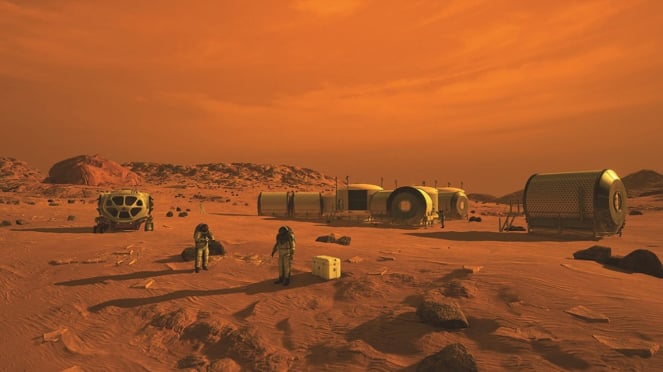
Ilustrasi koloni manusia di Planet Mars.
- SpaceNews
Details are still scant but the US$12,500 Phase I grant will not be used to build a prototype or spacecraft. Instead, it will allow Gosse to develop the concept to a point where he can compete for future phases or other funding sources.

Although many spacecraft instruments are powered by radioactive decay, they rely on conventional chemical propulsion to give sail to their targets. In theory, there are great advantages to using nuclear power, especially in reducing the fuel load.
Nuclear-Thermal Propulsion would heat a propellant such as liquid hydrogen until it becomes a plasma, which escapes through a nozzle, relying on Newton’s third law to send the craft in the other direction. On the other hand, it would use the energy produced by the reactor to power an ion thruster.
Rather than seeing these technologies as competitors for each other Gosse believes they can be combined using a “Wave rotor to decouple (the) reactor with motive gas,” to produce 1,800-4,000 seconds of specific impulse while avoiding the limits on mass to power ratios NEPs currently suffer.