Experts Fear Japan Releases Radioactive Wastewater Into Ocean

- Pixabay.


Japan – The government of Japan has decided to release radioactive wastewater from the tsunami-hit Fukushima nuclear plant into the Pacific Ocean, and it has entered its third wave.

Widodo Setiyo Pranowo, Principal Expert for Applied Oceanography and Coastal Management at BRIN's Climate and Atmosphere Research Center stated that the Indonesian government needs to be aware of and study this issue.
Pranowo said that the government should actively seek out the form of waste that has been dumped into the sea as the formation of such waste greatly affects the potential for pollution in the marine ecosystem.

"The first concern is if the nuclear waste is in liquid form, the possibility of it being carried by the current and then polluting everywhere can happen," Pranowo said, as quoted on Monday.
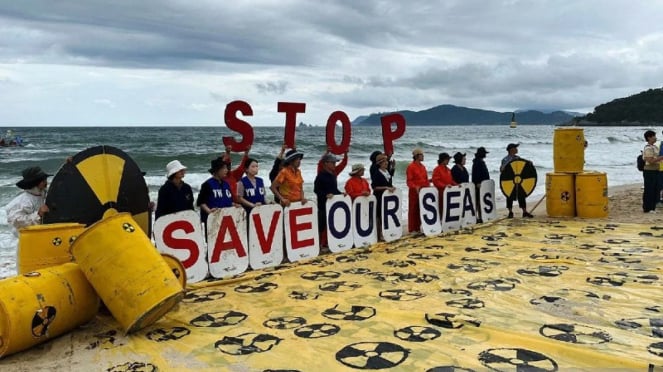
Para aktivits melakukan aksi protes tindakan Jepang melepaskan limbah air radioaktif dari pembangkit listrik tenaga nuklir Fukushima ke Samudra Pasifik, Busan, Korea Selatan.
- ANTARA FOTO/REUTERS/Minwoo Park/hp/aa.

According to Pranowo, if the nuclear waste has been placed in drums or tightly closed containers, then the research question that arises is that the containers are dumped to the seabed at a depth of how many kilometers.
"It is feared that the drum/container could leak because it gets pressure that exceeds its capacity, then a leak occurs,"
Environmentalist Muhammad Dhandang Purwadi is also concerned about the impact of nuclear waste disposal on human health.
This is because exposure to radiation for humans can increase the risk of various health problems, including cancer, thyroid disorders, and other diseases associated with radiation exposure.
Earlier in 2019, radioactive materials were detected in popular Japanese mascara and eyeliner products. This prompted South Korea's Ministry of Food and Drug Safety to suspend sales and order the return of the products.
According to the Head of the Center for Reactor Technology and Nuclear Safety of the National Nuclear Energy Agency (BATAN), this finding needs to be considered carefully, considering that the radioisotope detected was tritium.